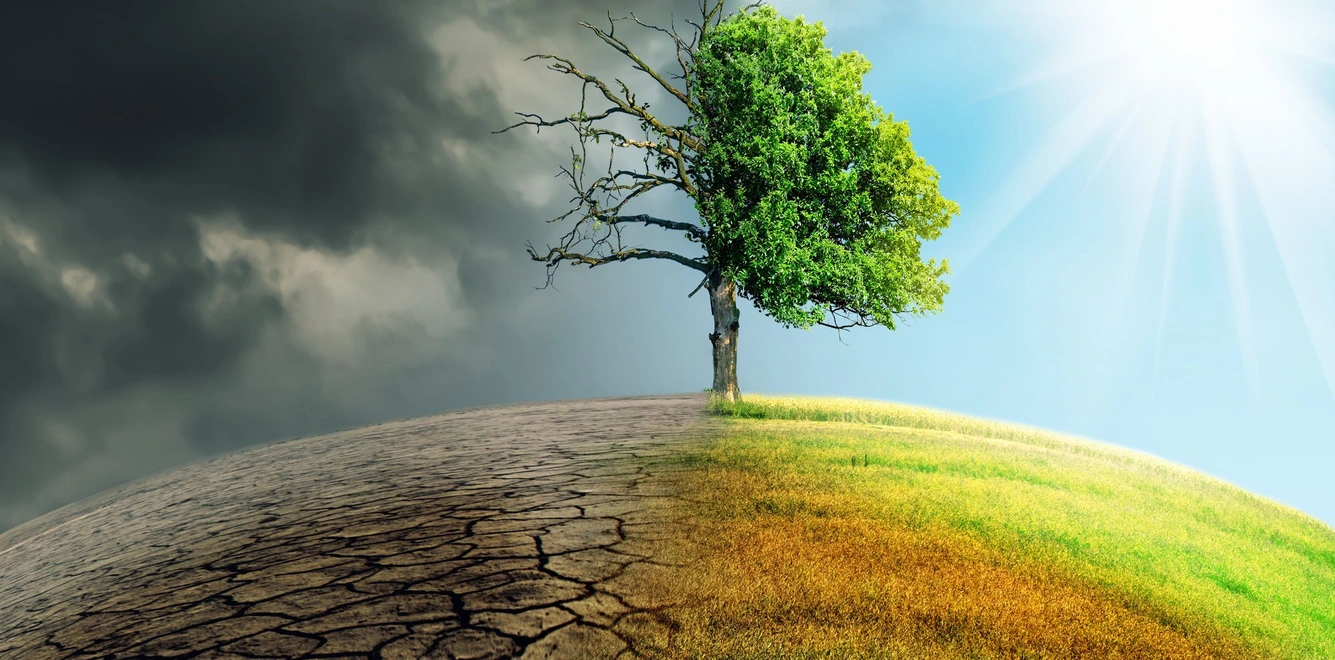
Climate change dictates a choice for farmers: technological renewal or ruin
The problems of agrarians in southern Ukraine, who have suffered significant crop losses in recent years due to global warming, have become particularly acute given that Ukraine, along with Moldova, ranked second and first in drought risks among 138 countries worldwide. An alarming situation also arose during the 2021 harvest: with hot days alternating with thunderstorms, farmers cannot get harvesting equipment into the fields.
How can agrarians adapt to growing crops in a risky farming zone to remain competitive? Anatoliy Polovyi, Head of the Department of Agrometeorology and Agroecology at ODESA, Professor, Academician of the Academy of Sciences of Ukraine's Higher School, shared his thoughts on this with Ukrinform.
CAUSES OF CROP LOSSES IN 2021
- The long-awaited launch of the land market in Ukraine coincided with the complication of climatic conditions for growing grain, oilseeds, and other crops in the southern regions. Abnormal heat in the Odesa region alternates with heavy rains, preventing agrarians from harvesting cereals, some of which have already fallen under squally winds. Are these temporary phenomena or signs of a gradual transition to a semi-desert climate zone?
- I believe that the harvest conditions of 2021 are a clear confirmation that climate changes are not happening gradually, but rather abruptly. Moreover, sometimes they outpace our ability to adapt, which can lead to serious losses of winter grains and other crops. Last year, farmers in Kiliya, Izmail, Bolhrad, and other districts of the Odesa region, who did not take care of crop insurance against drought damage, already suffered serious losses.
Regarding the impact of arid phenomena on the development of crops such as wheat or barley, under high temperatures, the intensity of photosynthesis decreases, and consequently, the overall productivity of plants. In addition, total evaporation from the soil surface increases, creating a lack of moisture for the development of cultivated crops and causing additional costs for the farmer. At the same time, global warming also has its advantages: the growing season increases, and opportunities for cultivating high-yielding post-harvest varieties, such as soybeans or millet, expand. Much depends on the ability and readiness of agrarians to react to changes: through irrigation of agricultural lands or replacement of traditional crop varieties with drought-resistant hybrids, application of new soil cultivation techniques that reduce moisture evaporation from the fields. In other words, farmers are faced with a tough choice: either updating agricultural technologies or ruin...
ARE THERE ANY ADVANTAGES TO GLOBAL WARMING?
I emphasize: due to climate change, many processes have been disrupted. On the one hand, the conditions for growing traditional crops for the south of Ukraine have worsened, risks of reducing their productivity and quality have arisen, including due to diseases affecting winter crops and lodging of cereals in the fields. On the other hand, the frost-free period has increased, which allows for the cultivation of later-ripening varieties. At the same time, in recent decades, frosts down to -8°C have occurred in May, as was the case in 2000 and 2003, as a result of which winter crop sowings in the active vegetation stage were damaged. Agronomists have never observed such a phenomenon throughout the last century.
- The crisis situation of 2020 also showed that many farmers in the south of Ukraine are not ready to farm in arid conditions. Some lost almost half of their harvest, others were on the verge of ruin, and some simply went bankrupt, ignoring crop insurance against drought. Therefore, I want to ask you, as the author of the textbook for students "Modeling of hydrometeorological regime on the productivity of agroecosystems" - which adaptation models for farmers are the most promising in the current conditions?
- In my opinion, the most important adaptation factor in Odesa region is the restoration and modernization of the irrigation system, which is more than 80% worn out, including the repair of pumping stations and canals, as well as the reconstruction of the on-farm network of water-regulating structures, which can improve the ecological and reclamation state of part of the semi-arid soils. And I see that the Cabinet of Ministers has already extended a helping hand to agricultural producers in Odesa region when it allocated UAH 240 million in partial compensation for losses suffered from the drought in 2020 and adopted the irrigation and drainage strategy in Ukraine for the period up to 2030, which provides for the implementation of a number of large-scale projects with a total cost of over $4 billion.
PILOT PROJECT FOR IRRIGATION RESTORATION IS BEING IMPLEMENTED IN ODESA REGION
It is noteworthy that the pilot project for the restoration of state irrigation systems was decided to be implemented in Odesa region - on the basis of the partially functioning Lower Dniester irrigation system. It is only important to take measures to prevent the loss of part of the targeted capital investments on the way to reclamation facilities that need restoration.
- By the way, while specialists from the Institute of Water Problems and Land Reclamation and the State Water Agency of Ukraine are developing and approving projects for the restoration of a number of facilities of the Lower Dniester irrigation system, the management of the Yasky agricultural enterprise "Agro-Olimp 2019" managed to launch a modern irrigation system in June 2021 for watering 600 hectares of agricultural land. As part of the project, 8 kilometers of inter-field pipes were promptly laid, two pumping stations were involved, and three circular sprinkler machines, which are controlled remotely - using a mobile application.
- Not so long ago, I also had the opportunity to visit the "Askaniyske" farm in the Kherson region, which is effectively managed. Local agrarians, who skillfully operate irrigation equipment and adhere to agrotechnology, harvested a 56-centner yield of spring barley per ear on a large irrigated area in a dry year. This is such a paradox: while agrarians of neighboring farms loudly complained about the drought, in "Askaniyske" they diligently worked for a high result, which, in fact, is provided by drip irrigation! Unfortunately, there are few such agricultural enterprises that have managed to preserve and even update their on-farm irrigation system over many years; mostly, semi-dilapidated water-regulating structures were dismantled in previous years.
However, I am convinced that irrigation is not a panacea, considering that by restoring pumping stations, main canals, and on-farm water-regulating structures, life-giving moisture can only be supplied to a part of agricultural land. For example, in the Odesa region, according to the regional state administration, it is planned to restore the functioning of melioration systems on an area of 157 thousand hectares during 2021-23.
Is this a lot or a little? A lot. Considering that the area of irrigated land as of July 2021 does not exceed 43 thousand hectares, and the development of a network of irrigation and drainage facilities is planned, according to developed projects, to put another 114 thousand hectares of arid land into circulation! And in total, for the implementation of the project "Reconstruction of irrigation systems of the Lower Dniester in Ukraine" until 2030, specialists of the Ministry of Agrarian Policy have justified the allocation of about 80 million dollars from the state budget and other sources.
IRRIGATION IS NOT A PANACEA
- In essence, the implementation of this project can be considered a kind of test of the ability to adapt to successful farming in a risky farming zone...
- Yes, while the total area of irrigated land in Odesa region is only 11% of the agricultural land of the region (227 thousand hectares). But I want to note that it was on irrigated lands that agrarians recently produced more than 40% of fodder, 80% of vegetables, 100% of rice, and more than 20% of grain crops. After all, the yield of grain, leguminous, and industrial crops on irrigated areas is almost twice as high as on rainfed agricultural lands. Perhaps, it is for this reason that the area of irrigated land in the world has doubled over the past 20 years, and the indicator of irrigated land to the total area of cultivated agricultural land has many times exceeded the Ukrainian one: for example, in Japan it is already 82%, and in neighboring Romania and Moldova - 30 and 17% respectively.
Meanwhile, the semi-arid climate zone in our country tends to expand, gradually moving from the southern regions in a northern direction. Therefore, farms can use irrigation as a factor to ensure consistently high efficiency of agricultural production, taking into account the availability of purchasing irrigation equipment by agricultural firms with a 25% state compensation for its cost, as well as preferential lending for the purchase of seeds of drought-resistant crop varieties and other opportunities, primarily the latest achievements of science and best practices.
- In other words, irrigation is only one, albeit a key link in the chain of farmers' adaptation to business conditions in a semi-desert?
- Exactly. Successful adaptation is possible as a result of applying modern agricultural technologies, fungicidal seed treatment, using regionalized winter varieties with a high tillering coefficient, resistant to lodging and arid natural conditions. However, I would not risk claiming that these requirements were taken into account in most agricultural enterprises in Odesa region: for example - this year, when the conditions for the development of winter crops were practically optimal. Therefore, I can predict, on the one hand, a higher gross harvest of grain and leguminous crops compared to the arid 2020. And on the other hand - a significant increase in grain infections with various diseases due to "damp" harvests - heavy rains during the ripening period of plants. This will undoubtedly lead to losses of 20 to 30% of the income of agricultural firms that neglected pre-sowing seed treatment with fungicides.
I also want to note that these results are not so much due to the July downpours, which were accompanied by squally winds that broke or bent the stems to the ground, as to the futile attempts of some agricultural producers to "save" on the purchase of elite low-growing wheat varieties resistant to lodging.
- And what agricultural technologies, in your opinion, provide the highest productivity of winter crops?
- I believe that in the arid conditions of southern Ukraine, many farmers justifiably use the No-till land cultivation technology, the main principle of which is: grain - to people, everything else - to the soil. Since minimal tillage is aimed at maximizing moisture retention in it and some replenishment of humus, as well as improving chemical and biological properties. In addition, the "zero" soil-protective technology tested by farmers in many countries contributes to the processing of post-harvest plant residues into nutrients. And what is no less important, it resists water and wind erosion of soils. We must also not forget about crop rotations, which are largely disrupted and, unfortunately, poorly observed.
Perhaps small farms should consider changing the structure of sown areas, mandatory crop insurance in conditions of increasing arid conditions, and switch from predominantly grain production to cultivating more drought-resistant millet crops, and if irrigation is available - to cultivating vegetable crops.
WHAT DOES SELECTION OFFER?
- And finally, a question about selection: do farmers have the opportunity to choose seed material for marginal crops resistant to the current extreme conditions of southern Ukraine?
- Undoubtedly, such an opportunity exists. Specialists of the Selection and Genetic Institute, as far as I know, are successfully working in the direction of adaptive selection of agricultural crops. And over the past 15 years, they have created and entered into the State Register 183 varieties and hybrids of winter soft and durum wheat, winter and spring barley, corn, sunflower, peas, soybeans, chickpeas, sorghum, alfalfa, sainfoin.
Many of the varieties they have bred are not just highly productive and early-ripening, but also drought- and frost-resistant, successfully passing variety trials both in Ukraine and in Turkey, Spain, France, Romania, Georgia, and other countries that have progressive technologies for cultivating grain crops. Moreover, some varieties, for example, the corn hybrid "Dialog" bred by Vyacheslav Sokolov and others, were created using DNA technology.
The use of seeds of new early-ripening grain varieties, resistant to extreme environmental factors, allows our farmers, who adhere to agricultural technology requirements, not only to achieve high yields of winter crops but also to grow two harvests per year. For example, after harvesting barley or wheat in July, they can sow agricultural land with "stubble" crop seeds – early-ripening hybrids of sunflower, soybeans, millet, or grow equally highly profitable vegetables and berries. In fact, such agricultural enterprises as the Kherson farm "Viko" in the Kherson region, "Stoyanov" in the Odesa region, and others have been harvesting two crops a year for several years, achieving high returns from irrigated land.
Perhaps this is one of those economic maneuvers used by agricultural entrepreneurs in Israel, Turkey, and other countries that operate in difficult climatic conditions? When the payback of projects for installing modern irrigation systems for agricultural land is ensured by additional profit due to the cultivation of repeated harvests of agricultural crops? I believe that studying the best practices of agricultural enterprises in these countries, which operate in risky farming zones, can be very useful for South Ukrainian farmers.
Mykhailo Aksaniuk, Odesa