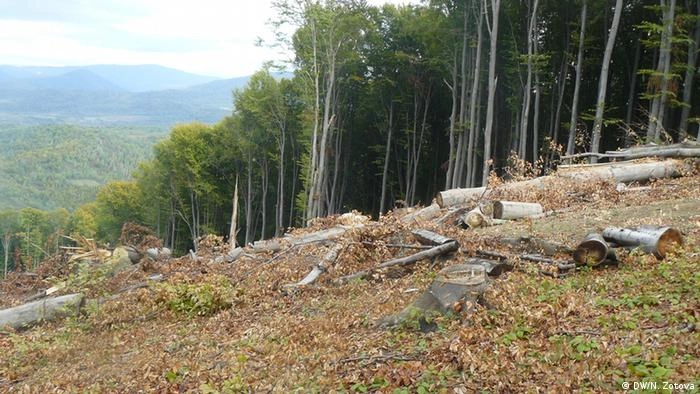
(Un)green country: what's happening to Ukrainian forests
The Ukrainian authorities have announced a large-scale environmental project aimed at greening the country against the backdrop of mass logging and unaccounted forests. President Zelensky promises to plant a billion trees. What is the state of the country's forests now?
Last week, Ukrainian President Volodymyr Zelensky announced an ambitious environmental project "Green Country", which provides for an increase in the forest area in Ukraine by one million hectares in ten years. To this end, one billion trees are planned to be planted in the next three years. DW found out why experts criticize this initiative and what is the state of Ukrainian forests.
No one knows the exact number
Ukrainian forests account for 15.9 percent of the country's total territory, 9.6 million hectares. At least, these data for 2011 are announced by the State Agency of Forest Resources. No current information is provided, as forest accounting has not been carried out for ten years.
At the same time, according to state statistics, the area of areas covered with forest vegetation as of 2019 was 8.8 million hectares (14.7 percent of the total area). This figure should be used as a guide when talking about the actual number of forests, says Andriy Andrusevych, an analyst at the public organization "Society and Environment". However, according to him, even this figure can be significantly overestimated. "The total annual area of logging in Ukraine, which is officially published, is more than 400 thousand hectares, and the area of forest reproduction is about 40 thousand hectares," the expert says. - In my opinion, no one knows the area of forests in Ukraine now."
Nobody's and neglected
The State Agency of Forest Resources of Ukraine insists that there is no tendency to reduce forest areas in Ukraine, except for those forests that belong to "reserve lands" - areas that are not granted for permanent use or ownership. As DW was informed by the agency, there were 0.8 million hectares of such forests last time, of which 0.3 million were field-protective forest belts. "Forests located on reserve lands are not assigned to specific forest users and are in an extremely neglected state. Forest management is not carried out in them, and the state of these forests is currently virtually unknown," the State Agency said. - They lack forest protection, forests are cut down as a result of illegal logging." Such forest areas, especially near settlements, turn into waste dumps, the press service adds. The accumulation of garbage in forests contributes to an increase in the number of forest fires, the State Agency assures.
The public organization "Ukrainian Environmental Group" clarifies that it is about so-called self-seeded forests, which have formed over the past 20-30 years on former fields. Ecologists estimate their area to be within 500 thousand hectares. Most of them can be found in the Carpathians, Polissia, and, partially, in the forest-steppe zone, experts indicate. Legally, they are not considered forests, do not have state protection, and as soon as such plots acquire owners and tenants, they are uprooted and used for agriculture. "They are being destroyed at a tremendous speed, and deforestation is occurring," states biologist and expert of the "Ukrainian Environmental Group" Yehor Hrynyk. In his opinion, it is necessary first of all to take care of the preservation of such forests before engaging in planting new ones.
Where will new forests be planted?
In fact, it is precisely thanks to the official accounting of existing self-seeded forests that the Ministry of Environmental Protection and Natural Resources is going to fulfill almost half of the president's environmental strategy plan. Currently, according to the ministry's plans, recently announced by the head of the department Roman Abramovsky, "to identify and preserve 300 - 500 thousand hectares of self-seeded and ownerless forests." The rest of the plan will be implemented through planting new trees and will aim to achieve 20 percent forest cover instead of 15.6. To do this, it will be necessary to create more than two million hectares of new forests by attracting new lands, the State Forest Resources Agency told DW. They indicate that this is potentially possible at the expense of lands unsuitable for agriculture (ravines, gullies, steep slopes, rocky screes, sands, etc.), as well as on reclaimed lands, clearings, and wastelands. It also refers to forest belts along roads, reservoirs, and fields.
Threat to other ecosystems
Large-scale afforestation of the territory of Ukraine is planned to be carried out in each region. "In the steppe and forest-steppe zone of Ukraine, afforestation (creation of new forests) will also be carried out on unproductive and degraded lands," the State Agency reported.
This is precisely what environmentalists fear most. "This can create huge risks for other natural ecosystems in Ukraine," Hrynyk points out. According to him, in Ukraine, the situation with steppes is now much worse than with forests due to their large-scale plowing. "If you plow a steppe or a meadow and plant an artificial forest, it will be the destruction of nature. This is an artificial ecosystem instead of a natural one," the expert says.
Dendrologist, employee of the Institute of Evolutionary Ecology of the National Academy of Sciences of Ukraine Ihor Kuzemko is also concerned about which trees will be planted as part of this project. "It's one thing if these are native trees, another thing if these are alien, introduced trees," the expert points out in a comment to DW. According to him, during one of the previous state programs to increase forests, he observed how steppes were plowed and "robinia, red oak were planted, that is, very invasive species that cannot be planted here at all" due to the threat to the existing ecosystem.
Unresolved problems: logging and irrational management
Experts interviewed by DW generally positively assess the idea of increasing the number of forests, but urge to do so taking into account the opinions of environmentalists. In addition, experts point out that other unresolved problems in the forestry sector should not be forgotten. According to expert Andriy Andrusevych, there are many questions regarding state forests, which are under the protection of foresters. "The forest is treated as a free resource. We do not know the real area of forests, the real area of clearcuts, about the compliance of logging that is reported - whether it is sanitary or continuous," says the DW interlocutor. According to him, forestry is currently conducted extremely opaquely and unsystematically. According to the expert, however, the situation cannot be resolved without a full-fledged reform of the law enforcement system and increased control over all responsible bodies.