Ecology at Stake: How the Authorities and Oligarchs Wage War for the Environment
Solving environmental problems is postponed indefinitely – deputies did not adopt laws on environmental protection. Which "agents" of oligarchs are blocking initiatives and whose interests do they protect?
In recent months, the authorities' efforts have focused on two important topics: the fight against oligarchs and environmental issues. Separate legislative initiatives allow killing two birds with one stone.
For example, the "anti-Akhmetov" bill proposes to significantly increase the environmental tax. If the document is adopted, the tax rate for carbon-emitting enterprises will triple, and their owners, among whom are the wealthiest Ukrainians, will have to pay additional billions of hryvnias.
This is not the only issue that concerns representatives of big business. In February 2021, two more bills were registered in parliament that could worsen the lives of the owners of the largest polluting enterprises.
The first will force oligarchs to modernize their factories, and the second will untie the hands of the State Environmental Inspectorate. It constantly complains that its employees are not allowed to inspect enterprises that pollute the environment the most.
The owners of large financial and industrial groups oppose such initiatives and successfully block them in parliament through controlled deputies. This is already openly stated in the entourage of President Volodymyr Zelenskyy.
Who tops the list of the largest polluting enterprises, what changes are proposed by the authorities, and why do oligarchs' agents oppose "greening"?
Environmental initiatives
The authorities have taken up ecology. In February, two bills were submitted to the Verkhovna Rada, which are intended to solve the problem of environmental pollution in Ukraine. Deputies considered both documents, but there were not enough votes for their adoption. Both acts were sent for a repeated first reading.
The first draft, "On preventing, reducing and controlling pollution resulting from industrial activities", was twice rejected by deputies: in mid-February and at the end of May.
The act implements the EU directive on industrial emissions, the introduction of which is provided for by the association agreement between Ukraine and the EU. It would seem that this point could be fulfilled without problems, but an "internal factor" intervened.
According to an EP interlocutor in parliament, deputies are being forced to withdraw support for the law by lobbyists for large energy and metallurgical businesses. Its owners are mostly the wealthiest Ukrainians.
Why are the oligarchs resisting? The bill, as its developers point out, is intended to fundamentally change the environmental situation. It provides for three revolutionary things.
Firstly, obtaining an integrated environmental permit will become mandatory. This is a single document instead of the current several, which establishes specific environmental standards for enterprises. In particular - the level of maximally acceptable emissions into the atmosphere, water use conditions, waste management measures.
The procedure for obtaining the document will become public. According to the developers, this will prevent backroom deals between businesses and officials and allow monitoring of emissions into water, soil and atmosphere, as well as noise pollution.
Energy and chemical enterprises, companies for processing mineral raw materials and waste management must obtain an integrated permit.
Secondly, these enterprises must undergo modernization in accordance with the best available technologies and management methods (BAT) common to EU countries.
This will contribute to a 25% reduction in harmful emissions, according to the authors of the document. According to President Volodymyr Zelenskyy, the modernization of domestic industry will take 10-12 years.
Thirdly, "on-pipe monitoring" 24/7 is introduced, where data on air emissions will become available to everyone in real time.
"The adoption of the bill implements important environmental norms, without which Ukraine will not be able to become an EU member and whose implementation should have started back in 2018," says Iryna Chernysh, head of the public organization Save Dnipro.
The second bill, "On State Environmental Control," is designed to solve one of the key problems of the State Environmental Inspectorate – to increase the amount of fines for not allowing inspectors to inspection facilities.
Currently, the fine for this is UAH 760. If the document is adopted, depending on the degree of environmental risk of the enterprise – low, medium, and high – the amount will increase to UAH 600 thousand, UAH 1.2 million, and UAH 1.8 million, respectively.
Another significant change is the elimination of duplication of powers of the State Environmental Inspectorate and other bodies – the State Fisheries Agency, the StateGeoCadastre, and the StateGeonadra.
"Currently, several controllers can go to the same object without coordinating their actions with each other. That is, certain powers are duplicated," explained the head of the State Environmental Inspectorate Andriy Malovany.
In addition, the project specifies the status of inspectors, salary categories, and the creation of an information and analytical system "Environmental Inspector's Cabinet".
"According to the World Health Organization, every 15 minutes in Ukraine, five people die due to poor environmental conditions, seven are registered as terminally ill due to contamination of drinking water, soil, and air.
Every year, 23% of adult deaths and 26% of deaths of children under five could be avoided if environmental risks were eliminated," the authors of the act note.
Despite the importance of the bills for improving the environmental situation, in their current form, they have little chance of passing in the Verkhovna Rada.
These acts do not fit into the interests of representatives of large businesses – from shareholders of the largest metallurgical and energy companies to owners of cement and agricultural businesses, which are among the hundred largest polluters.
Who pollutes nature
According to the Ministry of Environmental Protection and Natural Resources, in 2017, the mass of harmful emissions in Ukraine amounted to 2.58 million tons, discharges - 997.3 million tons, and generated waste - 366 million tons.
In March 2021, the ministry published a rating of the main polluting enterprises. However, the data only covers 2019.
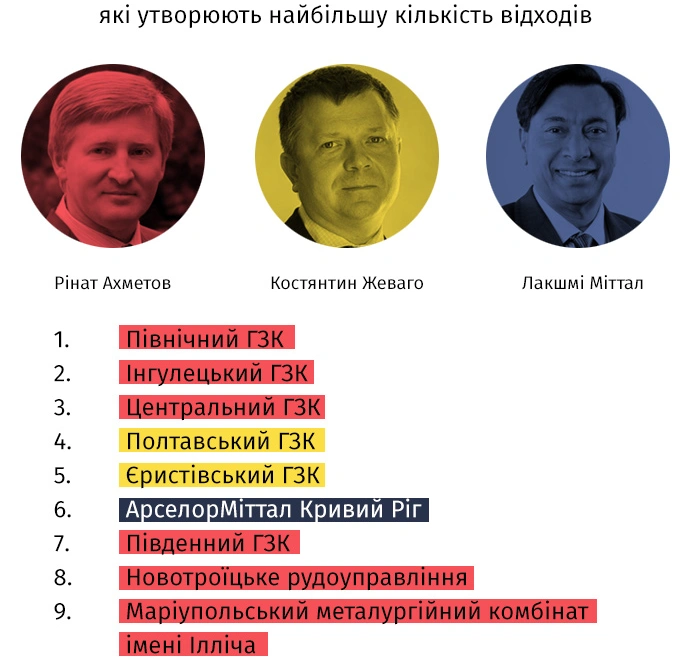
The rating is divided into three categories: air polluters, water polluters, and factories that produce the largest amount of industrial waste. About half of the enterprises on the list are located in the Dnipropetrovsk and Donetsk regions.
Most of the environmental polluting enterprises belong to Rinat Akhmetov. He has sufficient financial and media resources to block any initiatives in parliament, as government representatives have repeatedly stated. It seems the oligarch does not hesitate to use his capabilities.
The last illustrative story happened on May 21 during the vote on the draft law "On preventing, reducing and controlling pollution resulting from industrial activities."
During important votes, deputies disappear
The draft law, which is extremely important for the environment and the implementation of the agreement with the EU, was included in the agenda for Friday by people's deputies. This is a day when people's deputies traditionally have poor discipline: they either do not attend meetings, or they register but are not present in the hall.
The document failed and was sent for revision on the second attempt. 13 votes were missing. It is indicative that no deputy voted "against". 30 people's deputies abstained from voting, 57 - did not vote.
Who helped to fail the project? Many people's deputies from Ilya Pavlyuk's group, which the President's Office has long suspected of working for Rinat Akhmetov, did not give their votes. Also, deputies close to the richest oligarch, Musa Magomedov, Victoria Gryb, and Dmytro Shpenov, did not vote.
A large part of the group "For the Future", which is "understandable" to Ihor Kolomoiskyi, also did not support the document. "Batkivshchyna" and OPZZh, represented in parliament by 69 deputies, supported the bill with only one vote.
"This bill gives the Ministry of Ecology powerful powers for subjective conclusions. Tomorrow it will be possible to close any enterprise, any power plant, any enterprise that pays taxes," – argued Oleksiy Kucherenko, a deputy from "Batkivshchyna", for "abstaining" from voting.
After the project failed, the head of the "Servant of the People" faction, David Arakhamia, could not restrain his emotions and accused the people's deputies of "playing along with the oligarchs."
"Everywhere there are agents of oligarchs. We adopted a law on ecology to reduce environmental pollution. How sharply people went, excuse me, to the toilet! At the moment of voting, a large number of deputies simply disappear, and everything fails. As soon as you touch someone's interests," – Arakhamia was indignant.
The bills indeed affect the interests of oligarchs. Representatives of polluting companies do not hide that the proposed initiatives do not suit them.
Business destruction or unwillingness to invest in modernization
The press service of Rinat Akhmetov's DTEK company refused to comment on its influence on decision-making in parliament, but expressed dissatisfaction with the current versions of both environmental bills.
"The company has repeatedly expressed its position and adheres to it: the current version of the draft law "On State Environmental Control" contains ambiguous provisions that further regulate the environmental protection industry. The document needs significant revision to avoid the risks of termination of activities of enterprises in various sectors of the economy," DTEK said.
In the current version of the draft law "On preventing, reducing and controlling pollution resulting from industrial activities", according to DTEK representatives, the balance of state and private interests is violated and broad administrative powers of state bodies are laid down.
"The most important thing is to provide realistic terms for eco-modernization of industry and energy, taking into account the state of enterprises in these sectors and the readiness of the economy as a whole," the company noted.
Industry associations say that environmental reform "should not increase regulatory pressure on business and lead to the closure of enterprises."
Another key point of industry associations and businesses is that without subsidies, it is impossible to adapt to new requirements in four years. "The full implementation of draft law No. 4167 will cost 270 billion hryvnias. This amount is unaffordable for the state and business," Magomedov noted.
At the same time, Minister of Environmental Protection Roman Abramovsky emphasizes that all business requirements are taken into account in the projects. "If we approved the movement towards European integration, even enshrined this intention in the Constitution, the questions of why we should move in unison with the European Union sound very unclear," the minister said.
Andriy Gerus, head of the parliamentary committee on energy, does not believe that the proposed innovations will kill businesses.
"In addition to a possible lack of resources, there may also be a lack of desire to spend any resources on environmental modernization. In any case, a compromise must be sought, but I often observe that there is an unwillingness of large polluters to invest significantly in modernization," Gerus said.
There are also problems with the passage of the draft law "On State Environmental Control". According to Andriy Malyovany, resistance to its adoption is observed from representatives of DTEK, Darnytska TPP and "Centrenergo".
"There are lobbying groups that do not want the project to be adopted. However, there is political will and understanding that we need to "turn our face" to ecology. I hope that the lobby will give way. We will fight for the law," Malyovany concluded.