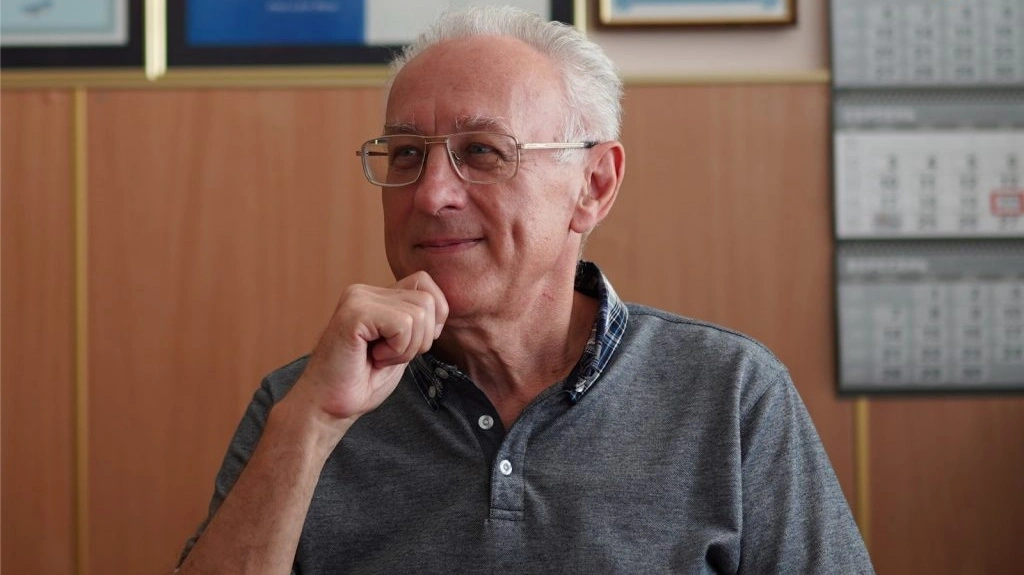
Rector of Odesa Environmental University: Southern Ukraine is threatened by desertification
Chernozems cracked under the scorching sun, dried wheat stalks on thousands of hectares of land, dehydrated beds of small rivers. This is the harsh reality that thousands of farmers in Odesa region faced for the first time a year ago - the southern steppes of Ukraine are slowly becoming a semi-desert without sands.
Serhiy Stepanenko, rector of Odesa Ecological University, told Ukrinform about the causes of current climate changes, which regions of Ukraine will inevitably experience the most significant impact of global warming, and how to adapt to farming in new conditions.
- Meteorologists' forecasts of unexpected weather changes alarm and worry residents of Southern Ukraine. For example, specialists of the Italian meteorological service ESTOFEX predicted stormy winds in Odesa region, heavy rains, large hail, and even a tornado for May 24, classifying the region as a level 1 danger. And although no tornado formed that day, rains and thunderstorms still hit the region, and then it got significantly colder, which also worried many Odesans: are these manifestations of warming or arid climate?
I'll start by saying that weather and climate are slightly different things. In the first case, we are talking about the actual state of the atmosphere and hydrosphere, and climate is the averaged state of the climatic system over several decades, which, in addition to the atmosphere and hydrosphere, includes the cryosphere, the upper soil layer, and the biosphere. Of course, weather conditions in May 2022 may differ significantly from May 2021 or another year. If they didn't differ, meteorologists would have much less work.
The short-term weather forecasts you refer to warn about weather conditions and their changes for up to 7-10 days, and such formidable manifestations as hail, whirlwinds, and tornadoes can be reliably predicted no more than 3-6 hours before they begin!
But such inter-annual variability of weather conditions, in particular the cold spring of 2021, does not at all indicate the nature of long-term changes in the Earth's climatic system, which climate scientists study. Unless, in combination, the changes may indicate that the climatic system has left the state of equilibrium in which it has been for the last 10 thousand years, and is rapidly approaching a critical limit. Scientists have called this process "modern climate change," which is primarily due to human activity. We, those who live in the era of these climate changes, need to get used to sharp inter-annual changes in weather conditions.
As for the already studied trend towards increasing aridity of the climate in Southern Ukraine, according to my colleagues - university professors Inna Semenova and Natalia Loboda - the average annual frequency and strength of such anomalous phenomena as droughts will increase. Sad facts also include the rise in air temperature, the decrease in water content, and the disappearance of small rivers that until recently had lakes in the region...
- Yes, perhaps those who link the hot summer weather of recent years with the alleged formation of a dry subtropical climate zone in the southern regions of Ukraine are right...
Yes, the trends of the last decade indicate a rapid approach to the state of precisely a dry subtropical climate in the South of the country, which is characterized primarily by an average annual air temperature above 14 degrees Celsius and a small amount of precipitation. Thus, in 2020, the average annual air temperature in Odesa was 13 degrees Celsius, and the average temperature in winter already exceeded 0 degrees Celsius.
But, in any case, the fact that climatic changes with a tendency to aridity are occurring in our region is a scientifically established fact. I want to note that we are talking primarily about an increase in the average annual air temperature as one of many manifestations of changes in the planet's integral climate system, which includes the atmosphere, hydrosphere (oceans and seas), cryosphere (ice sheets of Antarctica and Greenland), the upper layer of the earth's crust, and the biosphere. And in general, these changes are occurring in each of the listed components of the climate system. At the same time, ordinary citizens pay attention mainly to changes in the atmosphere. And for example, the changes that are currently occurring in the biosphere, some scientists call "the sixth great extinction," it is happening at very high rates compared to the fifth...
- Which is associated with the extinction of dinosaurs?
Exactly! Only with the difference that the current processes in the biosphere are even more massive compared to the "fifth extinction" and are developing much faster. We must also state the sad fact that over the past 60 years, the area of untouched land patches has decreased by 20 percent! Like shagreen leather, the areas of glaciers are decreasing, which leads to negative changes in the World Ocean and the atmosphere.
Returning to Ukraine, I will say that scientists state, unfortunately, faster climate changes in our home than on Earth as a whole. I will give such a fact: if the air temperature has risen over