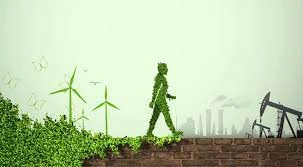
Ecology or economy? What you need to know about the European Green Deal
A year and a half ago, the European Parliament presented a new initiative - the European Green Deal (EGD). During this time, Ukraine, at the highest level, was one of the first non-EU countries to declare its support for the EGD and began negotiations on further participation. At the same time, there is still no clear understanding in society of what the EGD entails - threats or opportunities. We explain what it is and how the new European economic program will affect the Ukrainian economy.
The climate crisis is one of the main problems of the XXI century. Despite this, it is generally believed that any climate initiatives harm economic development and create problems for businesses at various levels.
In fact, in the context of sustainable development, it is climate-neutral initiatives that are the driving force behind the creation of a stable and competitive economy.
The most difficult issue here is the transition from "carbon" to "green" industry, especially for developing countries with economies focused on raw material exports.
To address this problem, members of the European Parliament recently presented the European Green Deal - an initiative that aims to transform Europe into the world's first climate-neutral continent by 2050.
Among the main points of the Green Deal are: responding to the challenge of global climate change and pollution; positioning the EU as a global leader in the development of a circular economy; transitioning to a sustainable food system; creating competitive conditions for the development of small and medium-sized enterprises, etc.
Given this, we explain how the EGD is intended to change the economic development of states, and what prospects and threats it poses for Ukraine.
What is the European Green Deal?
On December 11, 2019, European Commission President Ursula von der Leyen officially presented the EGD in the European Parliament. The key directions of this course are: transition to clean energy, combating climate change, construction and renovation, sustainable industry and mobility, reducing environmental pollution, biodiversity, and a sustainable agricultural policy.
Despite the fact that the main focus of the EGD is climate policy, the new European course is more about modernizing the economy and, as a result, stimulating economic growth in harmony between humans and the planet's natural resources. For example, within the framework of this initiative, "green financing" and investments of 260 billion euros annually are envisaged by 2030. All EGD funding will be primarily directed to "green" initiatives.
"The Green Deal is, in essence, an attempt to transform European economies and consumption patterns. At the same time, given the expected fundamental changes in the energy system, which are being discussed at the highest political level, the European Green Deal will also cause changes in the European Union's relations with neighboring countries," it is noted in the EGD description.
In the context of sustainable development, climate-neutral initiatives are the driving force behind the creation of a stable and competitive economy.
A radical structural reform will change the European trade and investment model. In 2019, the EU imported resources worth over 320 billion euros, most of which came from the Russian Federation. A large-scale reduction in gas and oil purchases will lead to a restructuring of the EU's relations with key suppliers. Countries such as Russia, Algeria, and Norway will ultimately lose their main export markets.
Since the EGD is a global initiative, it will also significantly affect the relations of EU countries with leading geopolitical players, including the USA, China, and Saudi Arabia. Therefore, in fact, "green" Europe will become even more dependent on the import of products and raw materials – that is, resources needed for the production of clean energy, in particular, lithium, cobalt, ionium, etc.
Prospects and threats of the EGD for Ukraine
One of the biggest problems of the EGD for Ukraine is the Carbon Border Adjustment Mechanism (CBAM), which aims to reduce carbon emissions and prevent carbon leakage from the EU to other countries (the transfer of "dirty" industries to third countries). The implementation of this mechanism will lead to additional taxation of goods imported into the country from foreign manufacturers with less stringent rules on carbon emissions.
The essence of CBAM is to protect domestic producers, encourage external partners to develop their own climate initiatives, and reduce the risks of carbon pollution. In practice, this mechanism should become a special tool for assessing the volume of CO2 emissions during the production of imported goods. Their price will be formed based on this assessment. The goal of carbon adjustment is to stimulate the market for goods with a low carbon footprint, as well as to support the application of mechanisms for payments for carbon emissions into the atmosphere in countries outside the EU.
At the same time, the authors of this initiative foresee the need to take into account the specifics of each sector of the economy and the probability of selective application of the CBAM mechanism, which may be one of its main risks.
Among the main consequences of the introduction of CBAM are the creation of a new form of trade restrictions for the export of goods from Ukraine to the EU, which implies a probable increase in price for the end consumer-importer, a potential decrease in the competitiveness of Ukrainian producers in the EU market, inhibition of investments, and deterioration of economic integration into the EU.
However, the degree of impact on Ukrainian exporters will depend on the form in which the CBAM mechanism will operate, whether there will be possibilities for exclusions from this mechanism, and other details of its implementation.
In parallel with the threats, the EGD offers many prospects for the development of the Ukrainian economy. In particular, the new European course gives our country opportunities to become a supplier of green energy (hydrogen) for the EU in terms of meeting electrification needs. For this purpose, the possibility of supplying a hydrogen mixture in the conditions of the gas transmission system is already being tested in Ukraine.
Among other advantages of the EGD, the following opportunities should be highlighted:
- to become a reliable gas transit country as a transitional fuel to the EU, which will be necessary for the gradual reduction of emissions from fossil fuels;
- development of joint projects for the use of hydrogen, which is an important tool for decarbonization of energy in general, as well as the transport sector - automotive, aviation and maritime;
- formation of common approaches to energy security to reduce the export dependence of Ukraine and EU countries on energy resources, in particular oil and natural gas, jointly build the EU's energy security policy, as the latter is poorly provided with internal resources, it has to import 87% of oil and 74% of natural gas;
- supply of rare earth minerals and metals necessary for the production of solar panels, wind turbines, lithium-ion batteries, fuel cells and electric vehicles (gallium, germanium, hafnium, graphite, phosphorites, yttrium, scandium, titanium, vanadium, etc.).
In conclusion
Given that the EGD poses some threats to the development of the Ukrainian economy, in the long term, such sustainable initiatives should become the driving force for the harmonization of all spheres of the country's activity.
Together with the EU, Ukrainian representatives should also develop a plan for the transition to carbon neutrality, using revenues from the export of carbon-intensive goods to diversify their economies.
Ukraine, in turn, expects support and actions from the EU aimed at a gradual increase in the price of CO2 emissions to preserve our economy. The key point is the application of the CBAM mechanism and its possible exceptions for Ukrainian exporters.
This can be achieved through systemic cooperation between Ukraine and the European Commission, whose representatives can guarantee support with attracting sustainable financing and transferring decarbonization technology to the energy sector.
What should the state do?
Considering the listed threats and opportunities, experts from the European Business Association propose that representatives of the Ukrainian Ministries of Energy, Economic Development and Agriculture, Environmental Protection and Natural Resources, as well as the Deputy Prime Minister for European Integration, take measures and refine the key aspects of implementing the EGD in our country.
Among these measures are: creation and approval of systems of state financing institutions aimed at fulfilling the goals of the green course; setting clear deadlines for financing decarbonization measures; developing an investment plan; approving the amount of financing for the implementation of measures defined by the EGD; developing a roadmap for the implementation of EGD initiatives.
It should be noted that an investment plan is envisaged for the implementation of the EGD initiatives, according to which at least one trillion euros of investments will be attracted during 2021-2030, of which 503 billion are EU budget funds, 114 billion are funds from national structural funds, 25 billion are funds from the European Emissions Trading System. Thus, fund funds account for 64% of all EGD investments.
The draft law on the introduction of CBAM is expected to be published by the European Commission in June 2021.
To attract investments and implement projects in Ukraine, regulatory transparency and certainty must be ensured, as well as coordination of projects together with the new initiative of the National Securities and Stock Market Commission on the implementation of green bond standards and "transition financing".
An important factor will be the restoration of trust in Ukraine from investors in renewable energy sources. For this, again, stable and transparent solutions are needed that will reduce investment risks and create opportunities for financing in the format of public-private partnerships.
It will also be appropriate for representatives of national business to have the opportunity to involve the Ukrainian side in public consultations conducted by the European Commission within the framework of implementing the EGD initiatives.
The participation of the Ukrainian side will prove the seriousness of Ukraine's intentions during high-level political meetings and strengthen its negotiating position, and business representatives will allow better preparation of the Ukrainian side's position for such meetings.
The draft law on the introduction of CBAM is expected to be published by the European Commission in July 2021. After that, the vector of further negotiations and plans will be determined. The Mechanism itself may come into force as early as 2023.
The material was prepared with the support of the European Business Association