Business models of Ukrainian companies are awaiting an ecological revolution.
President of "MHP Eco Energy", Deputy Chairman of the Board of MHP Oleksandr Dombrovskyi on the "green" course for Ukrainian companies, environmental investments and circular economy.
— The world is changing, and so are approaches to business. Do you agree with the statement that a business without environmental goals is doomed to failure?
— The other day I read an article in The New York Times. It talks about our near future: all products we consume will be produced taking into account greenhouse gas emissions and their impact on the environment.
You bought a T-shirt or a dress, and their tags will indicate how much water was used for their production and how much CO2 was emitted into the atmosphere. We may not pay attention to this, but it affects our lives and health.
Business cannot stand aside, because consumers also pay attention to environmental problems.
Check out the Worldmeter website. You will definitely be impressed by the figures on the amount of emissions, deforestation rates, and the amount of land affected by erosion. These figures should already be taken into account by companies in their business strategies.
— The government announced eco-changes in the Ukrainian economy in the next ten years. We are talking about the need to adapt business conditions to the European Green Deal, in particular, achieving carbon neutrality.
Are Ukrainian companies ready to change their development course?
— I believe that this issue is not just ripe - it is overripe. Not only in Ukraine, but in the world in general. We already have critical trends regarding global warming. This applies to any country on our planet.
The statements of the Ukrainian government regarding the "green" course are correct, but there are two key parameters. One can make correct statements and not take real steps, or one can create an internal system of motivation for businesses to implement environmental projects.
The Ukrainian economy, unfortunately, is one of the least energy-efficient and most energy-intensive in the world, so the statements are correct. The messages are correct, but practical steps need to be taken in terms of motivation.
Everything related to real tools for decarbonizing the Ukrainian economy, unfortunately, is at a standstill.
MHP has been dealing with these issues for a long time and successfully solving them.
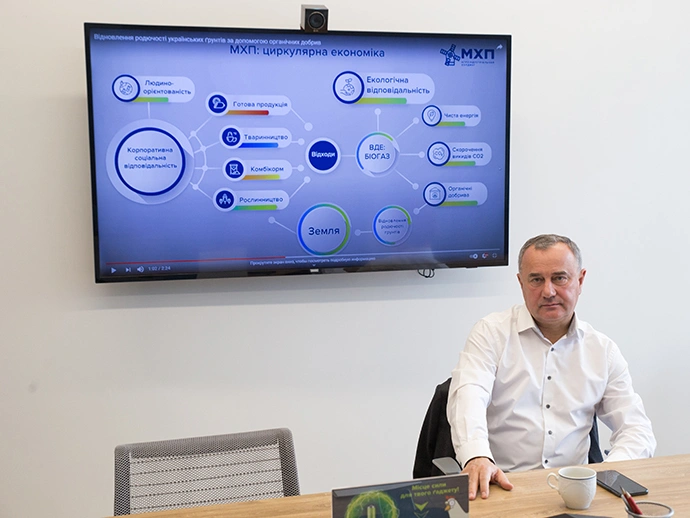
We operate according to a circular economy model, for which we see no alternative. It involves increasing business efficiency while simultaneously reducing environmental impact.
MHP has set a goal to become a carbon-neutral company by 2030. This means that we must produce renewable clean energy resources that we must consume 100% ourselves.
— What is your company doing for this?
— In December 2019, MHP agro-holding, as part of its sustainable development strategy, commissioned the first stage of the "Biogas Ladyzhyn" biogas complex with an installed capacity of 12 MW.
The facility is located near the city of Ladyzhyn in the Vinnytsia region and is one of the most successful private investment projects in Ukraine and Germany. It is being implemented in two stages with a planned energy capacity of 24 MW.
This is the largest biogas complex in the world for processing organic waste from broiler chickens. It allows converting chicken manure into clean "green" energy and organic fertilizers according to the highest global environmental standards. We strive for minimal waste.
In addition, with our partner – the German company Ellmann Engineering – we plan to launch the production and use of "green" hydrogen.
The integration of "green" hydrogen and biomethane technologies is a real breakthrough in clean energy.
Currently, MHP produces biogas, but thanks to innovative technologies, we will be able to obtain biomethane, which is a renewable analogue of natural gas. There is huge demand for it in the EU.
The topic of "green" hydrogen emerged two or three years ago. Ukraine, unfortunately, is also lagging behind here, although we have several companies that understand what and how to do. This requires large investments and developed projects. MHP has all of this.
Such breakthrough projects as our biogas plant will change the energy paradigm in the country in five to ten years.
In addition to consuming our own energy resource, we want to build a biodiesel plant to replace conventional diesel fuel with second-generation biodiesel, which we want to produce from waste.
The model of clean ecological production and adaptation of innovative changes at MHP is defined until 2030.
— Agriculture is among the biggest polluters of the atmosphere due to the significant amount of greenhouse gases generated as a result of intensive land cultivation and livestock farming. Is there a way out?
— When I found out that the agricultural sector is among the biggest polluters of the atmosphere, I was shocked and didn't believe it. In my mind, heavy industry, chemical industry, and energy could be in the first place, but not the agro-industrial complex.
That is why agricultural companies must control CO2 emissions and reduce them. MHP started moving in this direction a long time ago, and I have partially told you about our projects.
For agriculture, it is critically important to move towards organic production, as this helps reduce carbon emissions.
We have started producing organic fertilizers, thanks to which we can deacidify soils and restore their fertility, laying the foundation for Ukraine's successful future as a global agricultural player.
What is one of the key problems of Ukraine's agro-industrial complex over the last 50-60 years? We have catastrophically reduced the amount of organic matter we put into the soil. Organic fertilizers restore the humus component.
We are changing the soil cultivation technology, constantly monitoring soil quality. In 2020, we intensified cooperation with farmers who work around us: we gave them our organic fertilizers for free after biogas production.
There are already significant results. The quality characteristics of the harvest have improved. On a mineral, i.e., chemical, nutrition system, wheat yield is about 5 tons per hectare, and with the use of organic fertilizers - more than 6 tons per hectare.
In the first case, farmers received fourth-class wheat, and with organic fertilizers - third-class.
— You cooperate with many partners and companies in the agricultural sector. Are they ready to change their business approaches towards greening?
— Ukrainian agriculture has historically been focused on environmentally friendly production. We have always used biomass and organic fertilizers, we had wind and water mills in the grain industry. Environmental friendliness is in our mentality.
In the agricultural sector, our partners are ready to change. At the same time, the criticality of the environmental situation is global, planetary. Everyone will have to change, not just companies in the agricultural sector.
You have to start with yourself. Now you can see mountains of garbage near ponds or in forest belts. It is not sent to us from Mars, people themselves generate it.
— Is "green" energy and clean production a trend or a requirement of modernity?
— This is our reality and our future. We cannot but change as individuals, companies, communities, countries, and as the whole world. We must be clean and innovative to look forward. This is an expensive pleasure, but there is no other way.
MHP company is already on this path. What is its strength? In the fact that we find internal resources for ecological development, we have a unique vertical integration of the circular economy model.
We have been living in this model for several years and are proud that in many areas we are very competitive compared to many European and global companies.
We have many challenges, internal and external problems, but at least we understand that we must move and change. We must be cleaner, so we are already using "green" energy.
— What will stimulate the process of "green" changes?
— Ukraine is part of the world community. One way or another, we will move towards sustainable development and minimization of environmental impact. The European Green Deal will stimulate Ukraine to decarbonize its economy.
The EU has decided to introduce a carbon tax, and for the Ukrainian agro-industrial complex, the European Union is a large market for products. That is why Ukrainian companies will have to be responsible for greenhouse gas emissions.
If you want your products to be competitive and not have to pay huge carbon taxes, then prove that you did not pollute the environment during production!
If you can't do this, then you will pay the tax, and your products will become uncompetitive due to the price. An ecological revolution of consciousness awaits us all.