Environmental impact assessment in mining - a problem or a necessary element of sustainable development?
Back in 2017, the Verkhovna Rada of Ukraine adopted the Law "On Environmental Impact Assessment" dated May 23, 2017, No. 2059-VIII. From the very first days, its implementation immediately faced difficulties — a veto was imposed due to an appeal from the "Pig Farmers of Ukraine" association, whose representatives believed that the Law would stop the industry's operations. Only after considering the President's proposals was the Law supported in parliament and signed.
The mining industry also had many questions regarding this procedure, both at the stage of drafting the bill and within the framework of the Law's implementation. For example, the EIA procedure had to be carried out when subordinate acts had not yet been adopted. In addition, some subsoil users hold a large number of special permits issued simultaneously, their validity period also expired simultaneously, and extending the validity period required an EIA, which meant the simultaneous start of many procedures.
We investigated the issue of implementing the EIA procedure and identified the problems faced by ordinary mining companies.
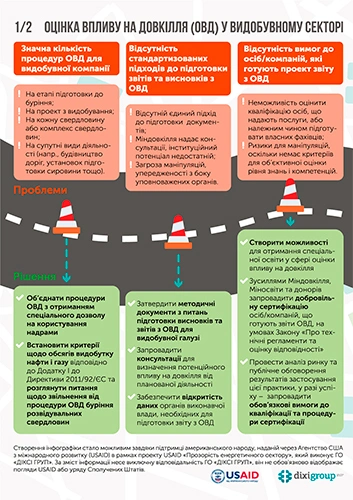
1. A significant number of EIA procedures that a mining company must carry out, especially at the stage of field development.
Example: According to a sample from the Unified EIA Register, 46% of EIA procedures carried out by "Ukrgasvydobuvannya" concern well drilling (this may include separate EIAs for each well, or for a complex of wells). This is almost half of the total number. That is, if EIAs are not carried out for each well, or if EIAs are not carried out at all at the exploration stage, it can be assumed that the number of such procedures will decrease by almost half.
To solve this problem, it is necessary to analyze which EIA procedures can be consolidated into one — for the field development project as a whole. Other solutions could be the unification of permitting procedures, or the establishment of criteria for mineral extraction, according to which exploration will differ from extraction and will not require an EIA. In this case, the regulatory burden on companies will decrease, and the public will have more information, as they will know about the entire project (and not just one well), and will not get lost in many announcements, reports, and hearings.
2. Lack of industry requirements and/or criteria for key stages of the EIA procedure (report, conclusion).
The law stipulates that the Ministry of Environmental Protection and Natural Resources is responsible for the normative and methodological support of EIA report preparation. The implementation of the Law in this part is carried out through the provision of consultations by Ministry of Environment employees to economic entities, while the institutional capacity of the ministry is often insufficient. In addition, the absence of criteria for determining the significance of environmental impact from mining activities creates room for manipulation for all parties involved in the EIA procedure - both for the company and for the permitting authority. A possible solution could be the introduction of industry-specific recommendations or standards for the development of reports and conclusions in the field of mineral extraction (for different types of minerals and different types of activities).
Example: in the EU, guiding documents have been developed for conducting EIA at various stages: screening, scoping, and EIA report preparation.
The first steps in this direction are also being taken in Ukraine. On March 2, 2020, the Ministry of Environment already approved Methodological Recommendations for the preparation of an environmental impact assessment report in the forestry sector, developed to improve the quality of EIA reports. A similar document would also be useful for the mining industry. For example, in Finland, a guide has been developed for conducting EIA for mineral extraction projects.
3. Lack of requirements for individuals/companies preparing the EIA report draft leads to certain misunderstandings in this area.
These reports are complex in their structure and should be prepared by qualified specialists, but currently, no requirements for the qualifications of individuals or companies preparing EIA reports are established in Ukraine.
No requirements for the qualifications of individuals preparing EIA reports are established in Ukraine
It should be noted that Directive 2001/42/EC on the assessment of the effects of certain plans and programmes on the environment and Directive 2011/92/EU on the assessment of the effects of certain public and private projects on the environment do not provide for such requirements, but only state that the persons preparing the report must possess appropriate qualifications. Certification mechanisms or other qualification confirmations have been implemented among Latin American countries (Guatemala, Nicaragua, Honduras, Costa Rica, Panama). In contrast, such practices are absent in the USA, Canada, and the EU. There is, however, a declarative approach in the UK (a company's statement indicating the availability of relevant expertise or qualifications of the experts who prepared it), but this declaration is not confirmed by relevant documents.
Instead, these countries pay attention to creating conditions for increasing awareness among companies that prepare EIA documents (training programs, courses, etc.). It should also be remembered that any certification or other confirmation of qualification is also a regulation that can entail corruption risks and increased costs of services. Therefore, our recommendation is to introduce such certification on a voluntary basis, and to make a final decision after concluding whether this innovation has justified itself in solving the problem, or not.
Also, the issue of proper conditions for the participation of civil society in the EIA procedure requires attention. There is still a large proportion of public hearings that are considered to have taken place in the absence of public representatives. Thus, out of 373 cases related to mining activities (a sample from the EIA register as of December 28, 2019), in 136 cases, public representatives did not appear at the hearings. At the same time, in all mentioned cases, the EIA procedure proceeded further. A separate aspect of this problem is the impact of the COVID-19 pandemic, due to which public hearings (in offline format) have been completely suspended for the quarantine period and replaced by the submission of written proposals.
The ways to solve this problem are compliance with the requirements of the Law of Ukraine "On Environmental Impact Assessment", which provides for the creation of proper conditions for public participation, as well as the creation of conditions for better consideration of proposals made during the discussion. Of course, not every proposal is subject to consideration, but civil society will be more active and constructive, knowing that under certain criteria their opinion will be taken into account.
Separately, it should be noted the problem of compliance with international legislation on EIA (Aarhus Convention, Espoo Convention, relevant EU directives) during the implementation of hydrocarbon extraction projects. A striking example is the case against Ukraine in the International Secretariat of the Aarhus Convention regarding the conclusion of production sharing agreements (PSAs) in 2013 without an EIA. The changes made to the legislation by the so-called "amber law" in December 2019, which abolished this procedure for PSA projects, and other regulatory acts only deepened the existing challenges.
In order to find a balance between energy independence and Ukraine's fulfillment of international obligations in the field of environmental protection, it is necessary to carefully study European practices and seek a compromise. A possible solution for PSA projects could be for the state to conduct the EIA procedure (such an option is provided for in the Law) based on the documents submitted by applicants for the relevant competition. But this is one of the options for discussion.
In European practice, quality EIA is an effective tool for planning economic activities and an important element for ensuring the sustainable development of the territories where these activities are carried out. The common task of the state and the public sector is to find a balance between environmental protection, business interests, and providing the state with strategically important resources.
Article from the journal №12, 2020 "ECOBUSINESS. Enterprise Ecology".