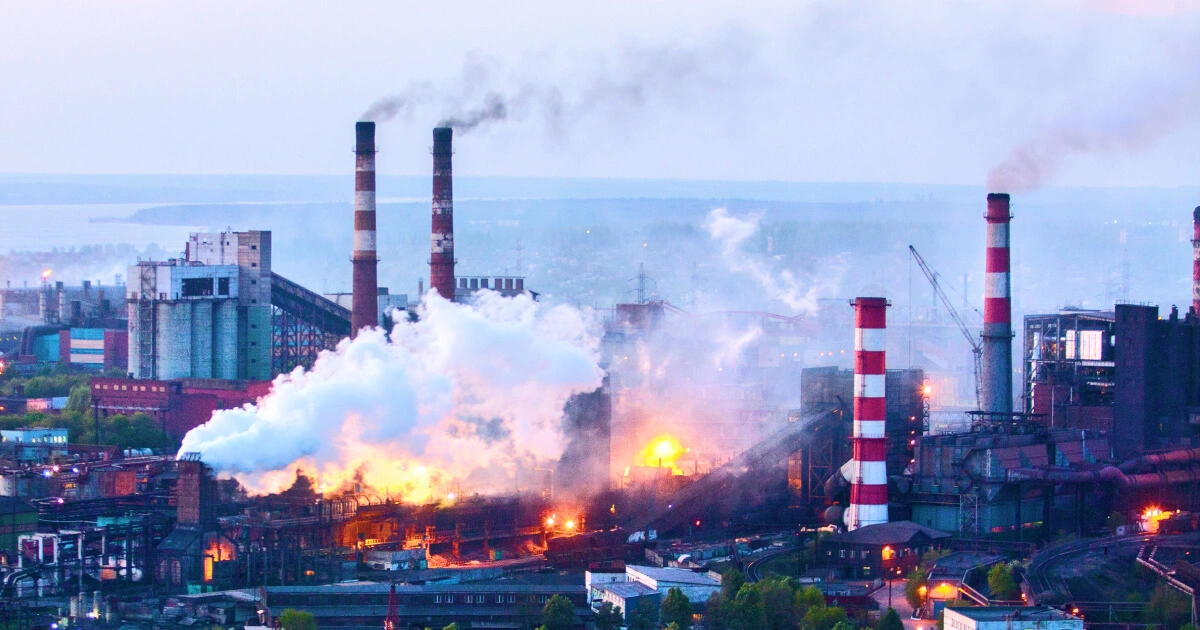
Smoke of the homeland: Ukraine is ready to launch CO2 emissions monitoring
The greenhouse gas emissions trading market will not start before 2026
Recently, the Cabinet of Ministers adopted three resolutions aimed at creating mechanisms for implementing a system for monitoring, reporting, and verifying greenhouse gas emissions. The documents are aimed at fulfilling Ukraine's obligations under the Association Agreement with the European Union. And ultimately - at ensuring the launch of a greenhouse gas emissions trading market in the country.
The greenhouse gas quota market is to become an alternative to the environmental tax on CO2 emissions. Experts believe that quota trading is a more advanced tool for stimulating environmental modernization of enterprises compared to the eco-tax. GMK Center investigated the stage of project implementation, what risks the new rules pose for the industry, and when the market can fully operate.
Regulatory framework
At the meeting on September 23, the government adopted three long-awaited by-laws aimed at creating a system for monitoring, reporting, and verification of greenhouse gas emissions (MRV) in the country:
"The adopted by-laws will ensure the launch of the system for monitoring, reporting, and verification of greenhouse gas emissions from 2021. This step has brought Ukraine as close as possible to creating a system for trading greenhouse gas emission allowances. After the launch of this system, it can be considered that our country has fulfilled its obligations regarding the implementation of Directive 2003/87/EC," notes Vladyslav Antypov, General Director of the Center for Ecology and Development of New Technologies (CERN).
From 2021, Ukrainian industrial enterprises designated by the Cabinet of Ministers will prepare plans for monitoring greenhouse gas emissions and approve them with the Ministry of Environmental Protection and Natural Resources. Reports on greenhouse gas emissions for the following year must be submitted by March 31, 2022. The reports will be verified by independent experts in accordance with established procedures and then submitted for approval to the Ministry of Environment.
It should be reminded that currently there is an environmental tax on CO2 emissions in the country, amounting to UAH 10 per ton. However, enterprises calculate their volume using different methods, and the data they provide are not verified.
"Pilots" took off
In 2018, three enterprises of the mining and metallurgical complex implemented pilot projects for the introduction of the MRV system: "Zaporizhstal", "Zaporizhkoks" and Central GOK. And also "pilots" were implemented by enterprises of the energy sector.
"In 2018, as a preparatory stage for the introduction of a national greenhouse gas emission trading scheme in Ukraine, DTEK Zaporizhzhia TPP implemented a pilot project to develop a typical MRV plan for thermal generation enterprises," recalls Olha Semkiv, acting head of the ecology department of DTEK company.
Currently, according to Olha Semkiv, DTEK enterprises, which are covered by the MRV law and which are likely to be included in the greenhouse gas emission trading system, are actively preparing for the start of carbon dioxide emission monitoring from January 1, 2021. In particular, the development of emission monitoring plans in accordance with the new legislation has begun, and employee training is underway.
"Our company implemented pilot projects within the framework of the Partnership for Market Readiness project at the largest industrial enterprises in Ukraine. Not everything went smoothly, but overall, it can be said that our industry is ready for a new system of greenhouse gas emission assessment. The biggest questions now are about the readiness of metrological services and laboratories. However, I believe that all shortcomings will be eliminated in the first year of the system's operation," Vladyslav Antypov is confident.
If we talk about the readiness of Ukrainian enterprises for the full implementation of MRV, then companies that set themselves the goal of completing their "homework" in 2020 are in better conditions. Namely: to bring technical documentation in line with the current state of the enterprise, to develop a monitoring plan and documentation to confirm greenhouse gas emission data.
"At the same time, enterprises would be better prepared for the implementation of the monitoring system if all the sub-legislative acts provided for by Law No. 377-IX were approved in time. Even now, despite the fact that three main resolutions have been approved by the Cabinet of Ministers, only one of them has been published. The rest are still unavailable for study. The same applies to the procedure for state registration in the Unified Register of installations that emit greenhouse gases. This document has not been published anywhere, but registration is the first step that companies will need to take. Thus, enterprises risk being left without the necessary tools. This will call into question the effectiveness of the monitoring system itself," says Olga Boyko, coordinator of the Committee on Industrial Ecology and Sustainable Development of the European Business Association.
Implementation practice
Data on CO2 emissions are submitted by enterprises in the mandatory form of the State Statistics Service "No. 2-TP (air)". Currently, there is no approved methodology for calculating greenhouse gas emissions in Ukraine.
"Each enterprise assesses CO2 emissions in its own way, so the data can vary greatly. After the implementation of MRV, enterprises will annually submit emission reports (operator reports, according to the law). And an approved calculation methodology will appear," explains Vladyslav Antypov.
It turns out that only after the implementation of the system for monitoring, reporting and verification of greenhouse gas emissions will the country receive clear data on the actual volume of emissions.
"Currently, each mining and metallurgical complex enterprise has its own conditional coefficient for calculating greenhouse gas emissions. And it can vary greatly among different enterprises. This is not some manipulation; it is a historically formed fact. But in 2021, everything will come to a single coordinate system, and changes are possible in both directions. And significant ones: the emission volume figure can change by 1.5-2 times just due to a change in the calculation methodology. How this will affect the quota trading market in general is difficult to say. The price of the quota, and therefore the cost and price of the manufactured product, will depend on the volume of emissions," - earlier in an interview GMK Center noted Vladyslav Varnavskyi, Head of Environmental Protection Department of Metinvest Group.
According to Vladyslav Antypov, there are currently certain risks associated with the implementation of the greenhouse gas emissions monitoring, reporting, and verification system.
1. Risks for system implementation
Currently, there are practically no risks for launching the system – all regulatory and legal frameworks have been adopted. The only remaining risk is the possible unpreparedness of the authorized body (currently the Ministry of Environmental Protection) to start approving monitoring plans from January 1, 2021. This may happen if there is a shortage of personnel for some reason.
2. Risk for enterprises:
Trading in law
The implementation of the MRV system is the first step towards launching a national market for trading carbon quotas. According to Andriy Hlushchenko, an analyst at GMK Center, this market is an alternative to the environmental tax levied on CO2 emissions. Quota trading is a more advanced incentive tool compared to the eco-tax. After all, it gives enterprises the opportunity to sell surplus quotas, creating an interest in modernizing production.
However, the quota trading market will not be launched without the adoption of a relevant law, which is not yet available even in draft form.
"As far as I know, there is no draft law on the greenhouse gas emission trading system yet," confirms Vladyslav Antypov.
In fact, it is still too early to write the text of a law on a mechanism that is completely new to Ukraine. After all, it is necessary to first understand how this system will function in our conditions.
"When I worked at the Ministry of Energy and Environmental Protection, all the experts I spoke with noted that it is necessary to first obtain the results of the MRV, analyze them, and only then adopt the law. After launching the MRV system, we have two years to monitor enterprises to accumulate data and a certain information base. If we make a mistake, the Ukrainian quota trading system will be ineffective," emphasizes Oleksiy Ryabchyn, advisor to the Deputy Prime Minister for European and Euro-Atlantic Integration, advisor to the Minister of Environmental Protection and Natural Resources.
According to him, Ukraine should launch a full-fledged emission trading system in approximately five to six years.
"It is necessary to decide whether our system will be separate or connected to the European one, to find out how our integration into the European energy market (ENTSO-E) will affect this, and so on. There are still many uncertain and volatile factors, including international ones, that can affect the final appearance of the Ukrainian quota trading system. This issue needs to be approached thoroughly. We still have time, but it is already necessary to start consultations with businesses," adds Oleksiy Riabchyn.
According to Vladyslav Antypov, in the process of creating a carbon emissions trading market in Ukraine, it is necessary to focus on the European Emission Trading System (ETS) model.
"I hope that we, as experts in this market, will be involved in the development of such a draft law. Especially since Ukrainian experts have shown their effectiveness in creating the MRV system," emphasizes the CEO of CERN.
Ecology vs. Economy
The emission monitoring and quota trading system is just one of the elements of ecology's impact on the economy, and not the most potentially dangerous one.
"If Ukraine does not implement a gas emission accounting system in time, businesses that will pay additional taxes for exporting their products may suffer," stated earlier Prime Minister Denys Shmyhal.
This refers to the introduction of a carbon dioxide emissions tax (Carbon Border Adjustment, CBA). It is a fee levied on goods imported into the European Union based on the volume of CO2 emissions during their production. If CBA is introduced, payments by Ukrainian companies when exporting to the EU could increase by €566.3 million per year. Almost 94% of this amount will have to be paid by mining and metallurgical and energy companies.
"Most domestic companies with experience in international markets realize that the quota trading market is still better than an additional tax on exports to EU countries. That is why the companies that are members of our Association support this initiative and are ready to actively cooperate," says Olga Boyko.
Ukrainian energy companies are also actively involved in these processes. The main goal of the quota trading system is to reduce CO2emissions, including from burning fossil fuels. That is, the impact on thermal generation will be significant.
"However, we count on cooperation and coordination with the Ministry of Environmental Protection and other stakeholders to ensure a just transition to low-carbon energy for consumers, residents of coal regions, and enterprise employees," notes Olga Semkiv.
Europe is still considering the design and content of the CBA mechanism. Potentially, a proper CBA mechanism and a quota trading system can become the basis for dialogue with the EU on exempting Ukrainian exporters from paying CBA. However, there are at least three such optionsfor mitigating the EU's environmental requirements for Ukrainian businesses. Specific possible mechanisms will be the subject of discussion with the EU.
"Our negotiating position is to prepare the necessary documents and proposals for our country's participation in the EU's "green" policy, initiate a dialogue as a structured mechanism for making joint high-level decisions on these issues, and develop a "roadmap" for Ukraine's participation in the Green Deal, etc. We expect that all this will create strong negotiating positions, in particular regarding mitigating the impact of CBAM on Ukrainian business," summarizes Oleksiy Riabchyn. "It should also be remembered about the Association Agreement, which provides for obligations not only of Ukraine but also of Europe. We do not want to have additional carbon borders between us and EU countries.".
Source <https://gmk.center/ua/posts/dim-vitchizni-ukraina-gotova-do-zapusku-monitoringu-vikidiv-so2/>