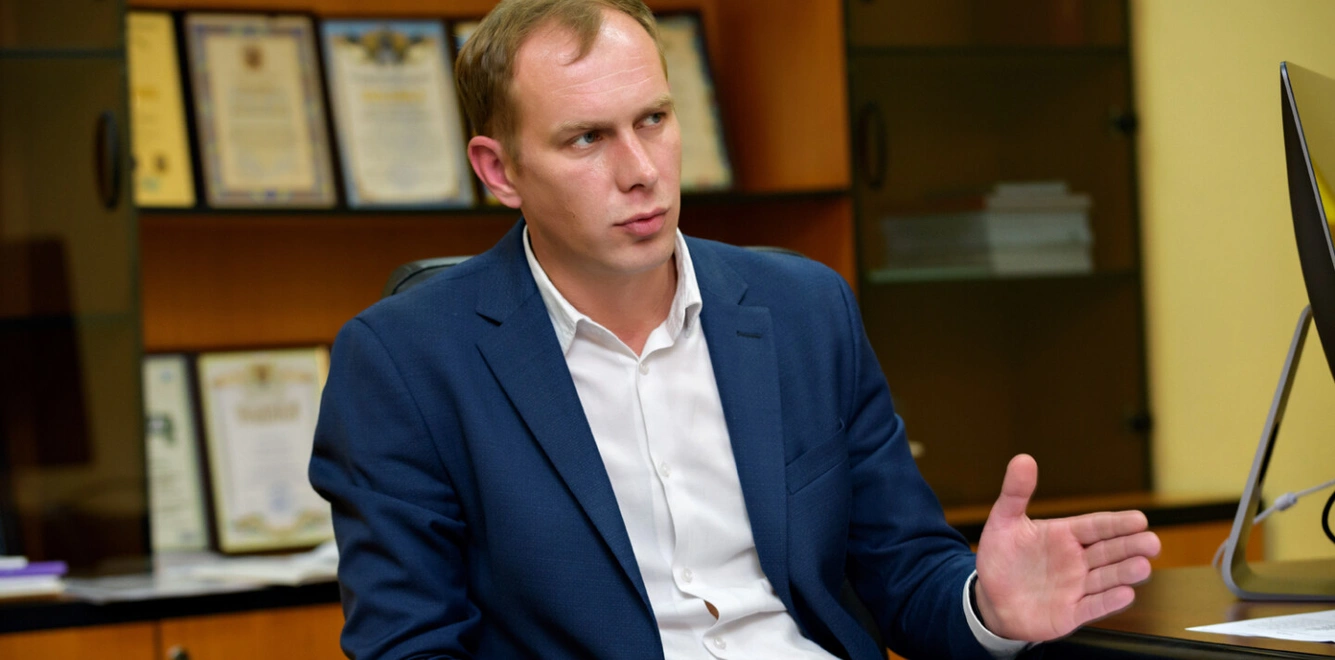
Andriy Malovany about inspections at any time of day or night, "DS" interview with the head of the State Environmental Inspectorate
Head of the State Environmental Inspectorate of Ukraine Andriy Malyovany - about multi-million fines, legislative changes and the construction of waste incineration plants at the expense of manufacturers
"DS". What are the results of the State Environmental Inspectorate's activities for 2020?
A.M. Last year, the State Environmental Inspectorate launched a number of important reforms. We started a territorial reform: instead of regional inspections, we are creating regional divisions. The Southwestern district has been created in Odesa and Mykolaiv regions, the Southern district on the basis of Zaporizhzhia and Kherson regions, and the Prydniprovskyi district on the basis of Dnipropetrovsk and Kirovohrad regions. This allows us to optimize the number of administrative staff and increase the number of inspectors.
The SEI also began the digitalization of the inspection. We developed terms of reference for the creation of the information and analytical system "Electronic Inspector", which will be fully operational this year.
A key element of the changes was the personnel reboot. We held many competitions to update staff in the central office and locally.
The number of fines imposed and damages identified is an important indicator of the SEI's effectiveness. But I believe that the most important thing is to encourage enterprises to work according to the law, modernize their facilities, and not harm the environment. In such a case, the issue of fines and damage assessment will disappear by itself. This is what the State Environmental Inspectorate works for.
Last year, we managed to achieve an increase in the inspection's funding by UAH 60 million (to UAH 440 million). Given the fact that 96% of our expenses are salaries, and very small funds remain for court fees, fuel purchases, and business trip payments, I consider the increase in funding a significant achievement. This allowed us to purchase the necessary equipment: quadcopters, high-speed boats to combat poachers.
"DS". How many enterprises were inspected, how many violators were identified, and how many fines were imposed? Which companies received the largest fines and for what?
A.M. Last year, we conducted more than 20,000 inspections, and the total amount of damage accrued to the state from violations amounted to UAH 2.1 billion.
The largest sanctions were imposed on ArcelorMittal Kryvyi Rih - UAH 11 million - for excessive atmospheric emissions. The entire amount was paid voluntarily and in full. Another UAH 10 million was paid by the Illich Iron and Steel Works. These are the largest figures for voluntarily repaid damages.
In addition, we had other multi-million dollar fines: for damage to forest plantations, for illegal subsoil extraction. For example, a court case is currently underway for a UAH 100 million fine that we imposed on a forestry enterprise in the Zhytomyr region for illegal logging.
"DS". Does the State Environmental Inspectorate often face resistance to collecting fines? Today, businesses often like to go to court and challenge the decision of a state body?
A.M. Unfortunately, this is quite a common practice: only about 40% of fines are paid voluntarily. The rest must be collected through court. And here the SEI faces problems: in the last four months, we did not have funds to pay court fees, which must be paid when filing lawsuits. This is one of the main arguments why it is necessary to increase the inspection's funding. We issued claims against violators for UAH 2 billion, but we did not even have UAH 10 million to go to court and collect these fines. But this year the situation will be different - for any voluntarily unpaid fine, we will go to court and defend the interests of the state.
"DS". Do inspectors face opposition to inspections, and how often?
A.M. This is a big problem, because today the fine for not allowing an inspector to conduct an inspection is only UAH 750. This is ridiculous money for violating enterprises. Therefore, Bill No. 3091 "On State Environmental Control", which is currently under consideration in the Verkhovna Rada, provides for a tenfold increase in fines for not allowing inspectors. In particular, for not allowing inspectors into an enterprise with a low degree of environmental risk, the fine will be 100 minimum wages, with a medium degree of environmental risk - 200 minimum wages, and with a high and highest degree - 300 minimum wages.
"DS". What else does this bill provide for? How important is it for the State Environmental Inspectorate and the sphere of environmental control in general?
A.M. It removes a number of burdensome restrictions, which increases the efficiency of the SEI. Today, in accordance with the Law "On the Basic Principles of State Supervision and Control in the Sphere of Economic Activity", it is necessary to notify the enterprise about the inspection, and include it in the relevant plan. This means that the enterprise, knowing about the inspection, can temporarily stop those facilities that pollute the environment. Sometimes we receive operational information about extraordinary risks due to the operation of an industrial enterprise, and in this case, we need to conduct an unscheduled, operational inspection. Such a possibility is provided for by Bill No. 3091.
Also, some enterprises make harmful emissions at night, and we do not have the right to conduct inspections during non-working hours. In my opinion and the opinion of environmental specialists, this is unacceptable: inspections should be conducted at any time of day or night.
I hope that this bill will be adopted by summer. We participated in the work of many working groups, in negotiations and consultations, so that a balanced law would result. On the one hand, it should exclude abuses by environmental inspectors, ensure transparency of inspections, and on the other hand, the State Environmental Inspectorate should have the functionality, the ability to come with an inspection and objectively control the work of enterprises and ensure the preservation of the environment.
The bill also provides for the elimination of duplication of powers of a number of bodies. State supervision and control in the field of environmental and nature protection activities will be concentrated in one hand. For example, we have the State Fisheries Agency, which has both economic functions and control functions. Therefore, its fish protection patrols should be transferred to the State Environmental Inspectorate, and the State Fisheries Agency will focus on economic functions, science, fish farming, etc. The same applies to the State Geological Survey, the State Forest Agency, which should retain administrative and economic functions, and environmental control should be assigned to the SEI. Our main goal is to check compliance with environmental legislation in many areas - in the field of forests, subsoil, green spaces, water resources, bioresources, fishing and hunting, and, of course, in industry.
"DS". Last year, it was planned to open a Clean Environment Office in Kryvyi Rih. Was it possible to do this and what will be its task?
A.M. Today, under the name "Office of the Central Apparatus of the State Environmental Inspectorate in Kryvyi Rih", it is already open. In Kyiv, we have a central office, which will focus on bio- and forest resources, surface waters, and control over the marine territory. And everything related to industrial pollution, control over special water use by industrial enterprises, atmospheric control, as well as laboratories - this will be in Kryvyi Rih.
Thus, the largest industrial polluters located in Dnipropetrovsk, Zaporizhzhia, and Donetsk regions will be controlled from Kryvyi Rih. In this city, we will gather the most professional specialists and environmentalists who understand industrial pollution, control of atmospheric emissions, and everything related to industrial waste and its disposal.
"DS". What tasks does the State Environmental Inspectorate set for 2021? What will be the focus?
A.M. The main task is to complete digitalization. We plan to switch to the electronic information system "Electronic Inspector". Inspectors will be equipped with video cameras (like patrol police officers) so that the inspection process of enterprises can be recorded. We will also provide them with smartphones or tablets so that they have databases related to the permitting system and the results of previous inspections at hand. This will allow the results of inspections to be displayed online in open access for the public, as well as to inform businesses about planned inspections: who will come and when, and what will be checked. Among other things, this will reduce paper workflow.
The second task is to begin implementing the bill "On State Environmental Control" after its adoption. We also expect the adoption of bill 2207-1d "On Waste Management".
The third task is the qualitative renewal of personnel, as well as the continuation of territorial reform, during which regional departments will be merged into districts. This will reduce administrative staff costs by 10-15% and, as a result, increase the inspection staff, which we lack.
In addition, we want to involve more public inspectors. We plan to create headquarters for public inspectors in each region and conduct their training. It is very pleasant that a large number of public organizations and individuals want to help in the fight against violations. Therefore, my task is to attract and train 1,500 public inspectors, approximately the same number as we currently have full-time inspectors in the State Environmental Inspectorate. With the current number of personnel, there are 50-60 inspectors per region - this is not enough to ensure effective environmental control. And public inspectors will become our eyes and hands in the regions.
A public inspector, together with employees of the State Environmental Inspectorate, can participate in inspections, conduct raids and inspections at the direction of the SEI, draw up relevant acts, protocols on administrative offenses, deliver violators to local authorities or the Ministry of Internal Affairs. And also check documents for the right to use wildlife objects, stop vehicles and inspect belongings, hunting and fishing gear, extracted products and other items.
And, of course, an important task for the current year is not to slow down the pace of inspections, of recording damages for any violations.
"DS". Only one waste incineration plant has been built in Ukraine, while in Europe it is a common phenomenon. What needs to be done to make waste management in our country more civilized?
A.M. This issue is beyond the competence of the State Environmental Inspectorate. Based on the results of inspections last year alone, we recorded over 1,600 illegal landfills, issued relevant orders, and recorded damages of UAH 35 million. Therefore, the problem of solid household waste (SHW) disposal is large-scale and affects every person in this country. For example, in the Lviv region alone, 90 settlements do not have contracts for the transportation and disposal of SHW at all. This means that garbage is simply dumped spontaneously. Therefore, such a system needs to be changed.
It is necessary to adopt a law that would give investors an economic incentive to build waste incineration plants. This can be done through the "producer pays" principle - when the product manufacturer is actually responsible for the subsequent disposal of their packaging and finances a special fund. Funds from this fund will go to the construction of waste sorting stations and waste incineration plants, as is done in civilized countries.
An information campaign is needed to convince people that waste incineration plants can be environmentally safe. For example, like in Vienna, where a waste incineration plant is located in the very center of the city near St. Stephen's Cathedral, or in Copenhagen, where a ski complex is built directly on the waste incineration plant.
In Singapore, for example, there are six waste incineration plants, one of which is completely private, and they ensure the processing of all waste in the country. We have only one plant - "Enerhiya", and it processes only a quarter of the garbage generated by Kyiv. And even this plant is already quite technologically outdated.
The solution to the SHW problem is clear rules of the game for business. Today, for companies dealing with waste, landfilling is cheaper, and this does not provide incentives for investors to build such plants. According to various estimates, 1-2% of SHW is sorted in our country, and 98% is buried in the ground. This is evil for the environment and future generations. Germany closed its last landfill back in 1986-1988, and we are decades behind.
The will to solve this problem today exists both in the environmental committee of the Verkhovna Rada and in the Ministry of Environmental Protection. I hope these efforts will be successful.
Source