On the verge of a garbage collapse
Why landfills are multiplying in Ukraine and how to deal with them
More than 470 million tons of industrial and household waste are generated annually in Ukraine. The population is decreasing, but the volume of garbage is only growing: on average, one person produces 250-300 kilograms per year. 93% of garbage is taken to landfills, more than 2% is incinerated, and 4.5% is recycled.
The situation with waste disposal in Ukraine is strikingly different from what is happening in the EU countries. 47% of household waste in the EU is sent for recycling, and this percentage is constantly growing. Another 28% is destroyed by incineration, producing energy that goes into heat and energy systems. And only 23% goes to landfills for burial.
Germany is the flagship of new approaches to waste management, where almost two-thirds of garbage is recycled, and only garbage purified from organic residues is allowed to be taken to landfills. The share of household waste there is minimal. Most old landfills are generally closed, and some have been repurposed for the burial of slag generated after garbage incineration.
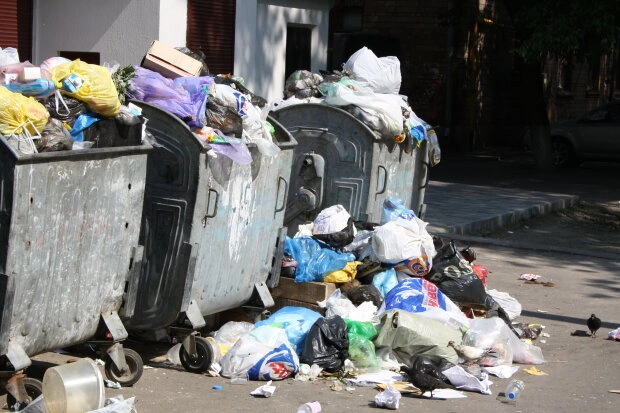
In Ukraine, landfills occupy more than 9 thousand hectares. This is the area of the entire city of Kremenchuk in the Poltava region or the city of Khmelnytskyi. A third of them do not comply with environmental safety standards. Harmful substances seep into the atmosphere and soil, into groundwater and surface water bodies, disrupt the functioning of ecosystems, and harm agriculture. And landfill gas emissions also have a negative impact on climate change.
Recently, the State Environmental Inspectorate inspected landfill No. 5 in Pidhirci near Kyiv, where most of the capital's waste is disposed of. We found a number of egregious violations. In particular, work on its reconstruction is carried out without an environmental impact assessment, waste is not sorted, for the disposal of which Ukraine has appropriate technologies, hazardous waste is disposed of - batteries, accumulators, energy-saving lamps. And this is far from a complete list.
Further operation of the outdated solid waste disposal infrastructure will have serious negative environmental consequences. And we already see this in the example of the disaster at the Hrybovytska landfill, after which the "travels" of Lviv garbage throughout Ukraine began.
But in addition to legal landfills, our country is also covered by a network of spontaneous dumps. One of the reasons is that 22% of the population does not have access to a centralized garbage collection system. Since the beginning of 2020 alone, the State Environmental Inspectorate has recorded 1613 unauthorized dumps, which caused damage to the environment amounting to more than 35 million hryvnias. Theoretically, local authorities should deal with them, but often they simply ignore their duties. The SEI has repeatedly brought regional officials to justice and will continue to do so. In the first half of 2020, 5374 protocols were drawn up for officials and responsible persons, and fines totaling 1.6 million UAH were issued. And it would be good if these fines were also increased so that officials would not be tempted to go against the law.
In Germany, local authorities are much more effective in combating illegal landfills. In the state of North Rhine-Westphalia alone, about 7 million euros are spent on this annually. Most importantly, the Germans hit offenders hard with large fines. For litter along the road - up to 500 euros, for attempting to dump household appliances in the forest - up to 300 euros, and if the garbage contains hazardous substances - up to 2.5 thousand euros. Against this background, Ukrainian sanctions for similar violations - up to 1300 UAH - seem ridiculous.
Despite specialized laws and the National Waste Management Strategy, which aims for half of our waste to be recycled by 2030, we are still very far from European standards.
To get closer to them, authorities at the central and local levels must act more effectively, responsibility for non-compliance with legislation should be strengthened, fines should cover the costs of eliminating the consequences of pollution, and at least the largest cities should be covered by a system of primary and secondary waste sorting.
In today's realities, the adoption of Bill 2207-1d "On Waste Management", which has already been adopted by the Verkhovna Rada in the first reading, is of particular importance. Among other things, it establishes the procedure for the collection, removal and processing of municipal waste, ensures the introduction of its separate collection and recycling, provides for requirements for the quality provision of waste management services and the calculation of fees for such services. We expect that, together with the revised Bill 3091 "On State Environmental Control", this document will give impetus to qualitative changes in the field of waste disposal and bring the country closer to the best practices of EU countries.